
About the Journal
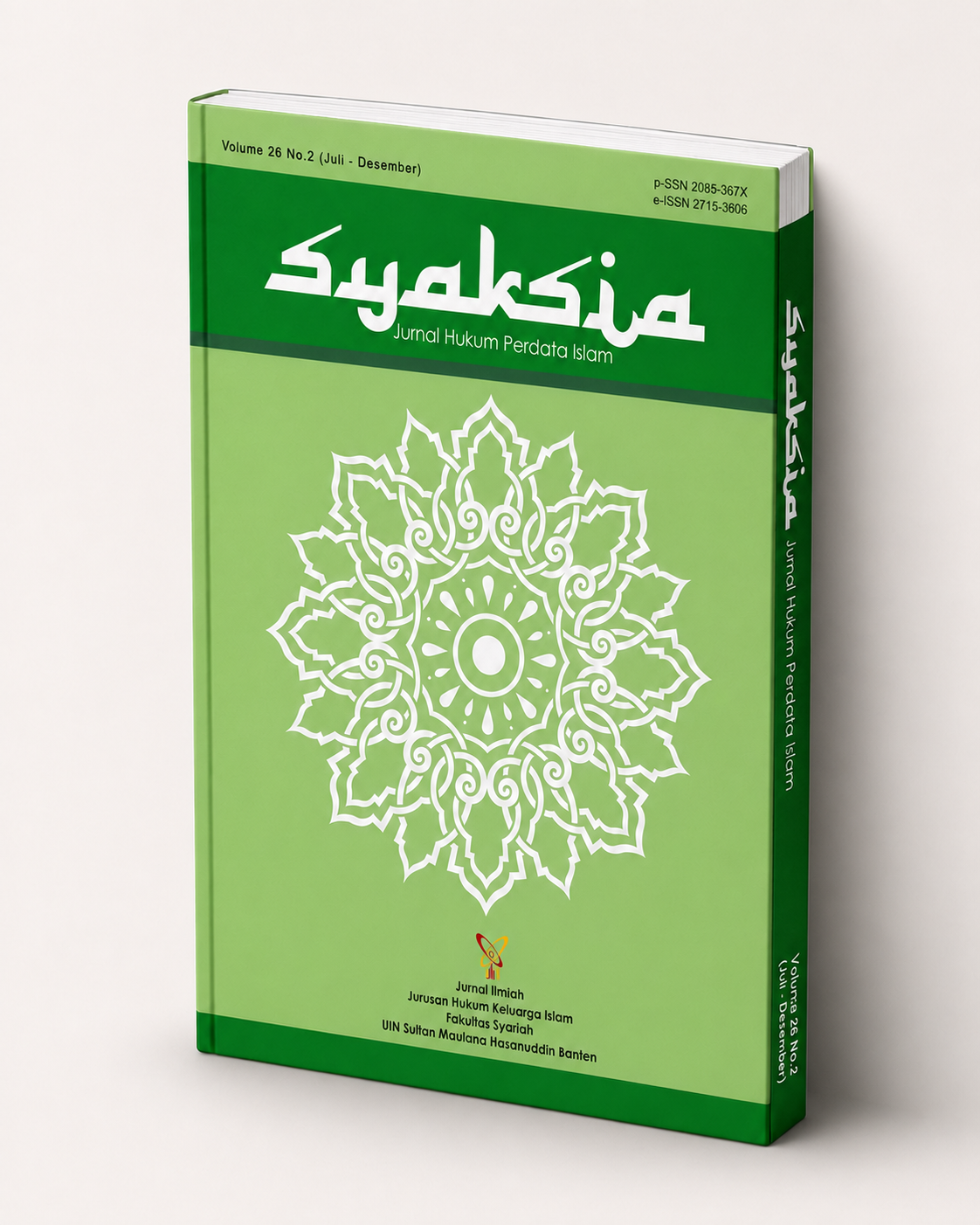 |
Journal title | Syaksia : Jurnal Hukum Perdata Islam | ||
| Initials |
SYAKSIA |
|||
| Abbreviation | Syaksia J. Hukum Perdata Islam | |||
| ISSN | ||||
|
Frequency |
Two issues per year (Jan.-Jun. and Jul.-Dec.) |
|||
|
DOI |
Prefix 10.37035/syaksia - DOI linked |
|||
| Editor-in-chief | Hapizul Ahdi, Universitas Islam Negeri Sultan Maulana Hasanuddin Banten, Indonesia | |||
| Managing Editor | Pitrotussaadah, Universitas Islam Negeri Sultan Maulana Hasanuddin Banten, Indonesia | |||
| Publisher |
Department of Family Law, Faculty of Syari'ah, Universitas Islam Negeri Sultan Maulana Hasanuddin Banten |
|||
| Citation Analysis |
SINTA | Google Scholar | Garuda | Dimensions | WorldCat | BASE |
|||
| Peer Review | Double Blind Review | |||
| Revenue Sources | Open Access (OA); No submission, editing, and publication fees |
Syaksia: Journal of Islamic Civil Law is an open-access scholarly journal that publishes studies on Islamic civil law, particularly Islamic family law, legal practices among Muslim communities, the relationship between Islam and gender, and the formulation of Islamic legal norms within socio-national contexts. With p-ISSN 2085-367X and e-ISSN 2715-3606, the journal provides space for original research articles, conceptual studies, scholarly reviews, and case reports that contribute academically to the development of contemporary Islamic law.
The journal is published twice a year and is managed by the Department of Family Law, Faculty of Sharia, Sultan Maulana Hasanuddin State Islamic University of Banten. This institutional position gives Syaksia a strong academic character in the study of family law, inheritance, marriage, family mediation, child protection, and other issues of Islamic civil law that are directly connected to the dynamics of Indonesian society.
The editorial board of Syaksia accepts manuscripts written in Indonesian, English, and Arabic. Submitted manuscripts must be original, unpublished, and not under consideration by any other publisher or journal. This requirement affirms the journal's commitment to academic integrity, novelty of ideas, and ethical responsibility in scholarly publication.
Each article submitted through the Open Journal Systems (OJS) platform is first assessed in terms of its alignment with the journal's focus and scope, compliance with the manuscript template, and similarity level. Articles that meet the initial requirements proceed to a double-blind review process, ensuring that the identities of authors and reviewers remain confidential throughout the evaluation. The final decision on article acceptance rests with the editor, based on the reviewers' recommendations.
The writing format follows the journal's technical requirements: 1.5 line spacing, Times New Roman 12-point font, and the inclusion of an abstract, keywords, endnotes, and references. Compliance with the author guidelines constitutes an important part of the initial screening process, since manuscripts that do not follow the journal format may be rejected before entering substantive review.
As an open-access journal, Syaksia makes its articles freely available to readers in order to broaden the exchange of knowledge in the field of Islamic civil law. Its publication fee policy is also author-friendly, as the journal does not charge submission, editing, or publication fees. This model strengthens the journal's role as an inclusive medium of scholarly dissemination for academics, researchers, legal practitioners, and observers of Islamic family law.
Syaksia is also connected to national and international scholarly indexing ecosystems, including SINTA, Google Scholar, Garuda, Dimensions, WorldCat, and BASE. Supported by editors, reviewers, and cross-institutional academic networks, the journal serves as a knowledge forum that encourages critical engagement with issues of Islamic civil law in Indonesia, whether in normative, empirical, or legal policy domains.