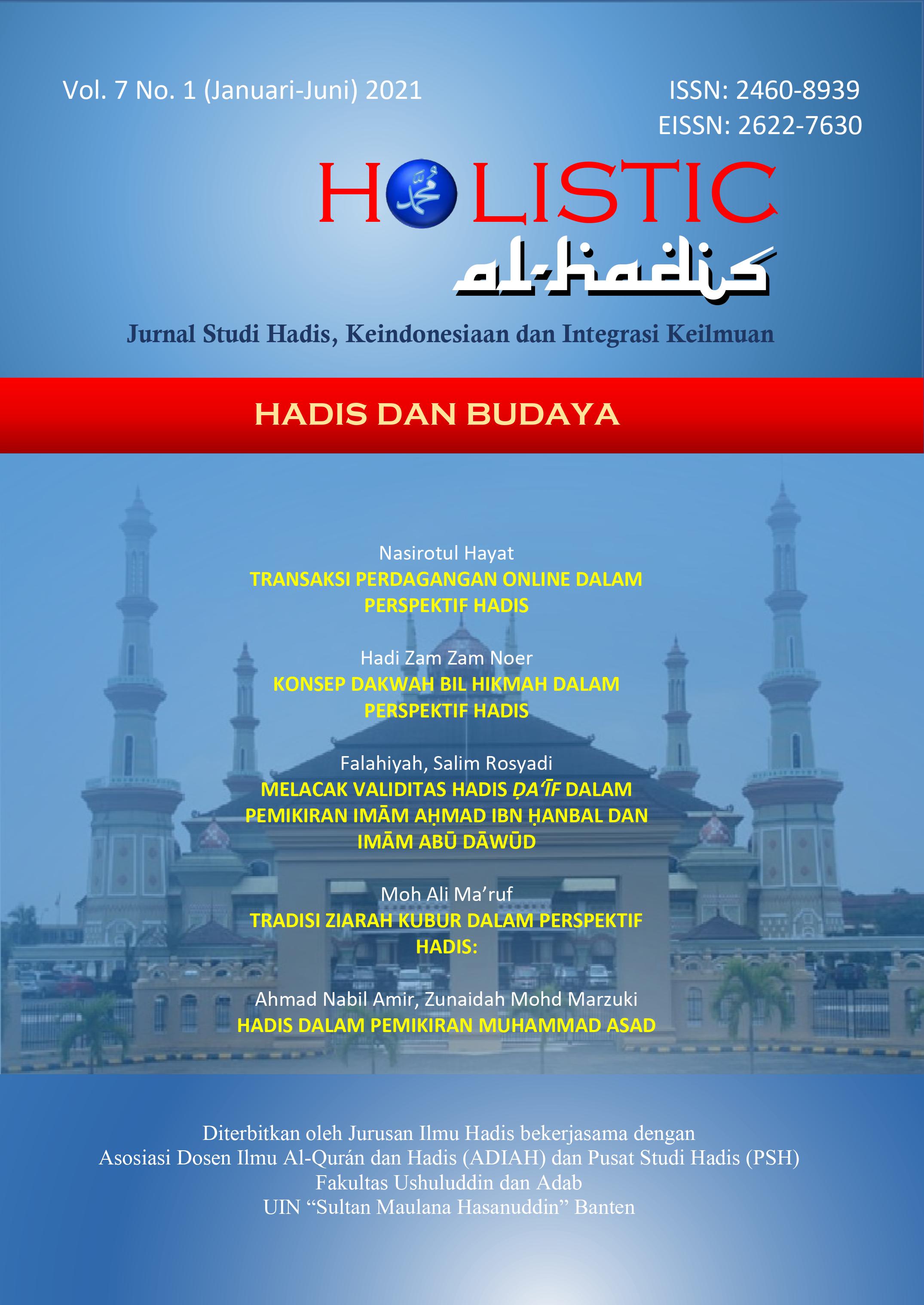
MELACAK VALIDITAS HADIS ḌA‘ĪF DALAM PEMIKIRAN IMĀM AḤMAD IBN ḤANBAL DAN IMĀM ABŪ DĀWŪD
DOI:
https://doi.org/10.32678/holistic.v7i1.5287Keywords:
Hadis,, Ḍa‘īf,, Imām Aḥmad,, Imām Abū DāwūdAbstract
Ḍa‘īf adalah lawan dari kata al-qawiy, yang berarti “lemah” , maka sebutan hadis ḍa‘īf dari segi bahasa berarti hadis yang lemah atau hadis yang tidak kuat. Sedangkan secara istilah diantara para ulama terdapat perbedaan rumusan dan mendefinisikan hadis ḍa‘īf ini. Banyak perbedaan pendapat antara ulama Muhaddiṡin dengan para fuqoha mengenai masalah periwayatan dan pengamalannya, ada yang membolehkan mengamalkan hadis ḍa‘īf dan ada juga yang melarang mengamalkan hadis ḍa‘īf. Imām Aḥmad dan Imām Abū Dāwūd termasuk ulama yang membolehkan mengamalkan hadis ḍa‘īf. Keduanya membolehkan jika dalam permasalahan faḍail al- ‘amal dan selagi tidak ada hadis lain yang menerangkannya. Sedangkan dalam perbedaan pendapat antara Imām Aḥmad Ibn Ḥanbal bahwa hadis da‘īf itu lebih disukai dari pada pendapat para ulama, sedangkan menurut Imām Abū Dāwūd ia berpendapat bahwa hadis Ḍa‘īf itu lebih kuat dari pada pendapat para ulama.
Downloads
Downloads
Published
Issue
Section
License
Authors who publish with this journal agree to the following terms:
-
Authors retain copyright and grant the journal right of first publication with the work simultaneously licensed under a Creative Commons Attribution License that allows others to share the work with an acknowledgement of the work's authorship and initial publication in this journal.
-
Authors are able to enter into separate, additional contractual arrangements for the non-exclusive distribution of the journal's published version of the work (e.g., post it to an institutional repository or publish it in a book), with an acknowledgement of its initial publication in this journal.
-
Authors are permitted and encouraged to post their work online (e.g., in institutional repositories or on their website) prior to and during the submission process, as it can lead to productive exchanges, as well as earlier and greater citation of published work (See The Effect of Open Access).