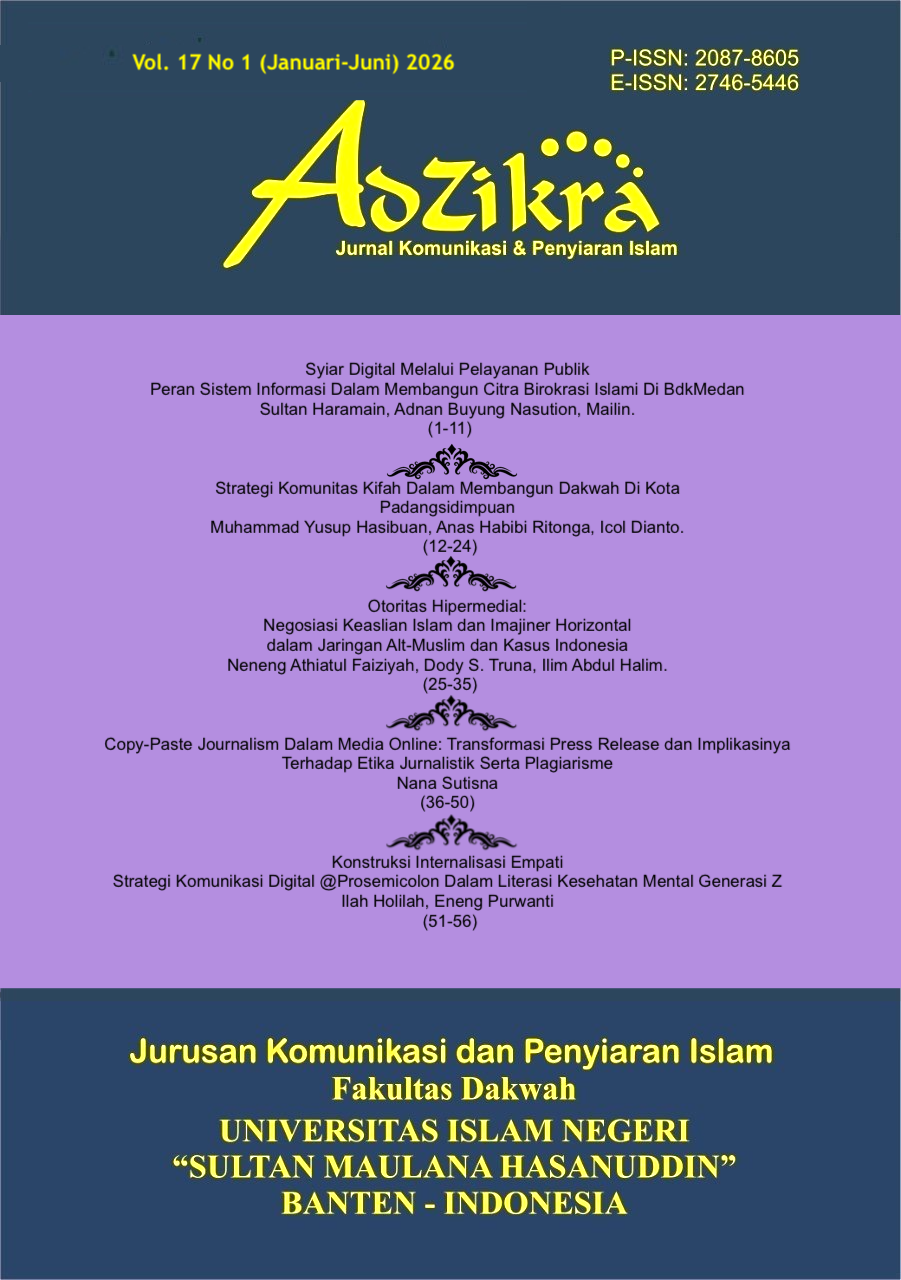
Otoritas Hipermedial
Negosiasi Keaslian Islam Dan Imajiner Horizontal Dalam Jaringan Alt-Muslim Dan Kasus Indonesia
DOI:
https://doi.org/10.32678/adzikra.v17i1.12981Keywords:
Hypermedial authority, Horizontal imaginary, Alt-Muslim Indonesia, Islamic authenticity, digital mediaAbstract
This article examines the transformation of religious authority in the global digital media landscape, focusing on the Alt-Muslim network as the primary case study while drawing comparisons with similar phenomena in Indonesia. Critiquing mainstream discourses that consistently frame Muslim religious practices as forms of anti-modern resistance, this study argues that platforms like Alt-Muslim instead represent a new form of cultural agency that actively negotiates the meaning of Islamic authenticity within secular modernity. Utilizing Nilüfer Göle’s concept of the horizontal imaginary and Alain Touraine’s theory of historicity, I identify the emergence of what I term hypermedial authority: a distributed, participatory form of symbolic power no longer dependent on traditional institutional hierarchies. Analysis of content from Alt-Muslim, Salatomatic, and the Halalfire Media network reveals that religious authenticity is no longer defined as blind adherence to textual doctrine but rather as an active investment of faith that transcends conventional sacred space boundaries. This study also explores the Indonesian case through platforms such as Islami.co, Ngaji.id, the Makna Islami podcast community, and the phenomenon of online reviews of mosques and Islamic boarding schools. Findings from Indonesia indicate that despite different historical and political contexts, the structural patterns of hypermedial authority negotiation are similar: digital spaces enable alternative voices to challenge the dominance of state orthodoxy and mainstream religious organizations. However, similar ironies also emerge: democratized access does not automatically eliminate representational biases and new forms of normalization. This study contributes to the sociology of religion, digital media studies, and transnational Islamic studies by offering a comparative perspective on how Muslims in different parts of the world use modern technologies to negotiate their place within the project of modernity.